Which attitude counts? Scheme-specific evaluation, fragile norms and institutional trust in Andalusian olive farmers' eco-scheme participation
Abstract
The European Union's Common Agricultural Policy steers farming systems through eco-schemes, voluntary annual payments for climate and environment-friendly farm practices, yet which farmer attitude actually moves participation is unknown. This paper tests the compatibility principle's specificity prediction on a survey of 97 olive farmers in Andalusia, Spain (69 current participants, 20 eligible non-participants, 8 former participants), fielded from 13 February to 10 August 2026 and analyzed within a theory of planned behavior frame extended by institutional trust. In ordinary least squares models of stated participation intention (n = 82), the scheme-specific attitude is the only predictor that survives Holm correction for multiple comparisons in the conventional model (B = +0.527, Holm P = 0.0343), while a general environmental orientation composite adds nothing (B = +0.113, Holm P = 1.000); an ordered logit agrees (odds ratio 4.18, Holm P = 0.0294). Institutional trust (2.96 of 5) correlates with the scheme attitude (rho = +0.502) but adds no incremental validity, and its interior is polarized between the cooperative (4.01 of 5) and the paying administration (2.57). A construct audit of the designed composites keeps 5 of 7, a measurement caution for farmer studies that print general-orientation scales. Free texts (n = 35) point to slope-fit reasoning and cooperative-delegated decisions. The attitude that counts is the one that names the scheme, and the trust that matters travels through the cooperative, so participation signals should name practices and delivery should run through institutions farmers already trust.
Keywords: agri-environmental schemes; Andalusia; attitude specificity; eco-schemes; institutional trust; olive farming; theory of planned behavior
INTRODUCTION
Andalusian olive farming is a social-ecological system. Recent theorizing treats social and ecological relations as jointly shaping learning, so soil and people cannot be steered separately ⟦janssen2026:c02⟧. The coupling is direct here; in the measured orchard trial, tilled plots lose an order of magnitude more soil than grass-covered ones ⟦ariasgiraldo2021:c02⟧. The ecological side answers slowly; building soil organic matter takes years to return benefits, often beyond planning horizons ⟦chapman2022:c06⟧. The human side sits under compound pressure; a recital of the EU's amending regulation, its formal preamble, names droughts, flooding and the energy and input price shock ⟦reg20241468:c02⟧. Agri-environmental policy is the steering lever, and it works only through voluntary choice; the 2023 to 2027 eco-schemes move where farmers opt in ⟦sok2021:c07⟧, so farmer behavior decides whether the lever moves anything.
The schemes elaborate on the former greening measures, tailored by each member state to its own land uses ⟦polakova2024:c02⟧. Spain's ministry presents them as the reform's main novelty ⟦mapa2025:c05⟧. They inherit a policy history in which environmental objectives carry little weight against income interests ⟦alons2017:c08⟧. Headline uptake looks emphatic, but the aggregate conceals sorting rather than transformation; 2023 adopters were larger, on average, than non-adopters ⟦redpac2025:c03⟧. Whether the scheme changes behavior or repays those already behaving, uptake rates cannot say. First-campaign evidence is only beginning to accumulate, and the participation literature remains concentrated outside southern Europe ⟦schaub2023:c11⟧.
The stakes concentrate in Andalusian olive groves, the European Union's principal olive-growing region ⟦colombo2018:c01⟧, where the paid practice has a documented case; covers cut soil loss and runoff against bare soil ⟦penuela2026:c07⟧. Practice adoption is not scheme participation. Much of the region's olive area already carries vegetation cover ⟦colombo2024:c01⟧, much of it falls short of the scheme's eligibility rules ⟦colombo2024:c03⟧, and the national survey recorded spontaneous cover before the scheme existed ⟦esyrce2015and:c01⟧. The same practices are partly obligations; avoiding bare soil in sensitive periods sits in the conditionality baseline, the mandatory minimum all aid recipients must meet ⟦francaviglia2023:c05⟧, and Spanish implementation promotes olive covers through requirements, not incentives ⟦lopezbernal2023:c01⟧. Several scheme options reward practices farmers already run ⟦peer2022:c07⟧, and cover effectiveness varies widely between farms ⟦gomez2026:c05⟧. The question is not whether olive farmers manage land in an environmentally recognizable way, but who signs up when a named scheme attaches prices, rules and paperwork.
Whether behavioral factors shape the sign-up decision under the 2023 to 2027 design is an open question in the Commission's behavioral evidence library ⟦dessart2019:c10⟧. The reform's structure sharpens the evaluation problem; some practices once compulsory are now addressed only through voluntary schemes ⟦cuadroscasanova2023:c04⟧, and Cuadros-Casanova and coauthors argue that the strengthened conditionality baseline protects less than the greening it replaced ⟦cuadroscasanova2023:c03⟧; cross-member-state design heterogeneity will make scheme-level effects hard to evaluate ⟦polakova2024:c06⟧. The behavioral evidence offers little prior comfort; in a systematic review, attitude associations were as often insignificant as positive ⟦schaub2023:c01⟧.
This paper reports a survey of 97 Andalusian olive farmers (69 current eco-scheme participants, 20 eligible non-participants, 8 former participants), fielded from 13 February to 10 August 2026, and asks which attitude counts. The outcome is stated intention, not observed enrollment; the window closed mid-cycle. The frame is the theory of planned behavior extended with institutional trust, a licensed move when additions carry incremental validity, predictive value beyond the core predictors already in the model ⟦ajzen1991:c03⟧ ⟦sander2024:c10⟧, and the paper makes three contributions.
First, a specificity test. The study stages the compatibility principle ⟦sok2021:c10⟧ as a clean contrast under one live scheme, pitting scheme-specific against general environmental orientation in one model. Second, a measurement caution grounded in the construct audit. Before any model is read, the audit asks which designed composites survive; scoring decisions around the fragile norms composite belong to that caution. Third, an institutional-trust extension test built so a null still carries texture. The trust battery spans the cooperative, the regional administration, payment stability and perceived fairness; a qualitative strand probes the cooperative as information source and paperwork channel.
The literature places the test in the planned behavior, norms and trust literatures and states four expectations. The Methods section describes the survey, measures and analysis. The Results report the sample, the regressions, the robustness suite, the remaining nulls and the free-text themes. The Discussion reads the specificity contrast, locates the trust null in the cooperative channel, turns the audit into a measurement caution, and draws bounded design implications.
LITERATURE
Planned behavior in farm decision making
The theory of planned behavior remains the default model of farm-level environmental decisions, with 124 farmer applications, scheme participation among them ⟦sok2021:c09⟧, and dominance alongside random utility theory in adoption research ⟦canessa2024:c07⟧. Policy must be designed around the target group's behavioral characteristics ⟦bartkowski2022:c02⟧; economics alone is insufficient because norms, identity, risk and trust mediate adoption ⟦ranjan2019:c10⟧. The model distinguishes attitude, subjective norm and perceived behavioral control ⟦ajzen1991:c01⟧ and admits predictors with incremental validity ⟦ajzen1991:c03⟧. Control predicts behavior only where it reflects actual control, which for enrollment sits partly in administrative hands ⟦sok2021:c02⟧, and perceived action space narrows where regulatory predictability and flexibility are limited, as documented for rotation decisions ⟦gutschow2021:c02⟧. The extension that matters is toward governance, where a major participation synthesis adds legitimacy and trust ⟦sander2024:c10⟧, operationalized for a scheme whose administration writes, inspects and pays.
Attitude specificity and the compatibility principle
Two review findings frame the question: farm-related environmental attitudes return insignificant in roughly half of cases ⟦schaub2023:c01⟧, and a favorable business attitude was never significant in the eight studies measuring it ⟦schaub2023:c12⟧. The compatibility principle explains the ambiguity, since constructs predict best when they share target, action, context and time ⟦sok2021:c05⟧; compatible measures explained 57 percent of intention variance versus 40 percent incompatible in the review that articulated the rule ⟦sok2021:c06⟧. Only a third of farmer applications meet the principle ⟦sok2021:c10⟧, so much attitude noise is a general measure predicting one named enrollment. Where the measure matches the object, scheme-specific attitudes are positive in 68 percent of cases ⟦schaub2023:c02⟧. Counter-signals remain: environmental considerations mattered little for cover crops across four regions ⟦kathage2022:c02⟧, yet concern predicted the most demanding pollinator eco-scheme options ⟦munozulecia2025:c04⟧, and Andalusian growers of abandoned fields rated environmental goals lower than still-producing peers ⟦carmonatorres2023:c03⟧. Because economic motivation dominates the five-country survey behind the Commission's behavioral taxonomy ⟦dessart2019:c02⟧, the specific evaluation is where money meets practice.
Social norms are strong where manipulated and fragile where observed
The two types travel differently, injunctive pressure to conform, descriptive norms from what others are seen to do ⟦sok2021:c04⟧. Peer information more than doubled stated odds of continuing ⟦kuhfuss2016:c02⟧, collective bonuses beat unconditional equivalents in a stated-choice simulation ⟦kuhfuss2015:c09⟧, and two-thirds of joiners reported their practices already conformed, a deadweight signature, payments landing on practices already in place, which the Discussion returns to ⟦kuhfuss2016:c06⟧. Injunctive pressure can dominate stated decisions, a one-unit rise going with roughly twice the intended enrolled arable area ⟦massfeller2022:c04⟧. Longitudinally, social pressure is among the weakest continuation predictors ⟦gatto2019:c09⟧, and the synthesis scopes norms as decisive mainly for collective schemes ⟦sander2024:c01⟧. Identity is concrete: productive agriculture still symbolizes good farming as reviewed in the Commission's taxonomy ⟦dessart2019:c01⟧, Mediterranean farmers name productivity and experience their leading good-farmer concepts ⟦topp2024:c01⟧, and network communication about a practice ranks among the strongest adoption predictors ⟦han2023:c02⟧. In olive country the backdrop turns against the paid practices: catch crops read as dirty management to 95 percent of citrus farmers nearby ⟦cerda2022:c01⟧, untilled fields carry social disapproval ⟦sastre2017:c03⟧, clean-field identity runs through Mediterranean olive groves ⟦penuela2026:c02⟧, and the good-farmer identity seems to discourage participation elsewhere in Europe ⟦sander2024:c04⟧.
Institutional trust and administrative experience
Institutional trust earns its slot through its object, the administration. The same synthesis reports distrust of government motives transferring to the schemes institutions run ⟦sander2024:c08⟧. Institutional trust associates with participation where generalized trust never does ⟦schaub2023:c04⟧, trust in the managing authority predicts longer continuation ⟦gatto2019:c06⟧, and trust is among the least-tested constructs despite positive signals where included ⟦canessa2024:c02⟧. Legitimacy splits the same way, farmers rating the familiar action-oriented scheme more legitimate than a results-based proposal citizens preferred ⟦vainio2021:c01⟧. Trust in the paying administration, in advisors and in policy stability are separate objects, kept separate in this study's measure. Administrative experience sits outside attitudes altogether: knowledge of regulations lowered perceived administrative workload ⟦mack2019:c02⟧ and enforcement experience raised it ⟦mack2019:c05⟧. Experienced burden predicts more negative perceptions of cross-compliance payment policy itself ⟦mack2021:c02⟧. Controls experienced as mistrust can offset a scheme's trust signals ⟦devries2019:c05⟧, and occasional inconsistencies revive memories of prior mistreatment, eroding trust in new policy ⟦devries2019:c06⟧.
Uptake evidence under the 2023 to 2027 rules
Uptake evidence is young but large: 19.2 million hectares enrolled by 2024, 88 percent of the eligible area and 77.5 percent of applicants ⟦redpac2025:c04⟧. The instrument is a voluntary annual payment per eligible hectare for climate- and environment-friendly practices ⟦homet2024:c08⟧, yet the CAP impact assessment modeled enrollment on purely economic drivers that behavioral evidence overstates ⟦dessart2019:c09⟧. The closest behavioral parallel, a structural model of 361 US landowners' intention to (re)enroll in a conservation program, found norms carrying the largest path ⟦thapa2024:c01⟧. Ex-post evidence linking design to actual decisions remains scarce ⟦canessa2024:c06⟧: interviews across regions converge on low payments, opportunity costs, poor fit, bureaucracy and inflexibility ⟦bartkowski2023:c02⟧, and olive motivations remain little studied ⟦rodriguezsousa2020:c10⟧. Projected payments fall below the scheduled 136.7 euros per olive hectare once the envelope binds ⟦colombo2024:c06⟧; long-term continuity is not assured on 88 percent of Andalusian mountain olive farms facing high abandonment risk, as reported at second hand ⟦carmonatorres2023:c10⟧. Perceived risk outruns measured risk: a four-season Andalusian rainfed trial found yields indistinguishable across soil-management systems ⟦duranzuazo2020:c02⟧, and erosion control brings no visible yield return, so the payment supplies an incentive farmers otherwise lack ⟦penuela2026:c05⟧. Design detail matters: payment certainty is the most-cited specific criterion ⟦bartkowski2021:c02⟧, and Andalusian sloping-olive choices favor practice-based over results-based designs ⟦villanueva2024:c01⟧.
The four expectations
The survey therefore tests four expectations. E1: the scheme-specific attitude predicts participation intention, and E1a: the general environmental orientation adds nothing beyond it. E2: norms predict intention, with estimates sensitive to scoring rules. E3: trust contributes to intention beyond the planned-behavior core. E4: adverse administrative events are more common among non-participants than participants, an exploratory contrast.
METHODS
Design, population and procedure
We used a structured online questionnaire with open-ended items, a mixed design centered on the quantitative strand. The bilingual instrument, Spanish primary with an English toggle, was a single-page application with auto-save, ten sections and a 15 to 20 minute design target. Respondents gave informed consent; participation was voluntary and anonymous; data were held in Germany. An Andalusian geography scholar informally reviewed the instrument; we did not pilot it. We offered no incentives, and no reminders are recorded.
Fielding and sample
We fielded the survey from 13 February to 10 August 2026. Recruitment went by email through farmer associations and cooperatives, which gated and forwarded the link; with no public sampling frame, this is convenience sampling with an incalculable response rate. The export holds 112 rows: 97 farmer rows, the analysis population (69 currently participating, 20 eligible non-participants, 8 former participants), plus 11 cooperative or organization representatives and 4 agricultural advisors. Fifteen rows never submitted; no row is dropped on submission status alone, the filters running through completeness. Two coverage facts qualify the sample: 15 of the 97 rows are flagged complete but stopped before the last section; 12 farmers give no usable intention response. The filters arrive at 85 usable pooled branched outcomes, 81 common pooled cases and 82 primary-outcome cases with complete predictors. The cooperative is an information source for 71.1 percent of the 97 (multi-select).
Measures
We scored six composites, worded at the scheme object as in payment-program applications ⟦thapa2024:c07⟧, on available items with at least half of each scale answered (Appendix 1). Alphas run from 0.625 (folded orientation, items sign-scaled so higher always means more environmental) to 0.819 (institutional trust), with intervals in Appendix 1. Perceived behavioral control is scored separately, comprising capacity to perform and autonomy over performance ⟦sok2021:c03⟧; perceived control relates positively or not at all to participation in prior agri-environmental scheme studies, as the review evidence records ⟦schaub2023:c08⟧. The trust items cover the regional paying administration, the cooperative, advisors, payment stability, inspection fairness and payment reliability, trusting a policy rather than interpersonal ties ⟦devries2019:c09⟧. Participation intention is three role-gated branch items, one per cohort, recoded to a single five-point measure (branch items in Appendix 1); the cohorts answer different items, making the recoded measure the primary outcome. Intention is the theory's most immediate behavioral antecedent ⟦sok2021:c01⟧ and, with perceived behavioral control, a joint predictor of behavioral achievement ⟦ajzen1991:c02⟧; the pooled branched outcome is a secondary reading, entry and intensity having distinct-stage precedent ⟦massfeller2022:c05⟧.
A construct audit of the instrument as designed kept 5 of 7 composites; the design reflects integrated frameworks giving identification, group norms and collective efficacy roles in environmental action ⟦fritsche2018:c01⟧. Both failures are two-item pairs: farmer identity, with items at opposing poles of a relative-priority wording, and collective efficacy, with mixed constructs. The scored instrument folds the identity items into the five-item orientation composite, group identity being tied to collective-action intentions ⟦schulte2020:c02⟧, and the collective items into norms. One of the 33 scored items falls below a 0.30 item-rest correlation (att_biodiv, r = +0.200); nothing was dropped on this rule-of-thumb evidence, and any drop needs a substantive argument (audit detail in Appendix 1).
Models, correction and robustness
We analyzed participation intention by ordinary least squares on the recoded five-point primary outcome (n = 82): model 1 enters the planned-behavior core (attitude, norms, perceived behavioral control) ⟦han2023:c01⟧; model 2 adds institutional trust and economic risk, testing independent prediction beyond the core ⟦bamberg2007:c02⟧; and model 3 adds the folded general environmental orientation composite and scheme familiarity, pairing decision-maker attributes with decision context ⟦epanchinniell2022:c01⟧; context alone cannot predict behavior without individual motivations ⟦gutschow2021:c04⟧. All models run on the common complete-predictor sample; the pooled branched outcome (n = 81) is estimated identically. The recoded outcome concentrates at the top of its scale, so estimator choice is itself a robustness question. The seven model 3 coefficients form one Holm family; the nine participant-versus-non-participant comparisons form a separate family with Benjamini-Hochberg false-discovery-rate values alongside in the frozen analysis package. Group comparisons use Mann-Whitney U with tie correction; we report Cohen d, and the rank-biserial sits in the frozen tables.
A robustness suite re-estimates model 3: HC3 heteroscedasticity-robust covariances; CRV1 clustering on a possible association identifier (13 groups of 1 to 23; identifier meaning unconfirmed); an ordered logit; a rerun omitting the 6 cases above the 4/n Cook threshold; an all-items-observed bound (n = 24); HC3 Wald tests of the added blocks; and bootstrap percentile intervals.
Missingness, power and the qualitative strand
Composite missingness runs 7.6 percent overall (2.52 of 33 items per farmer), clustering within respondents (diagnostics in Appendix 1); the mechanism is unidentified. The minimum detectable effect at 80 percent power (n = 82, seven predictors) is a partial correlation of 0.313 (f² = 0.109), larger under the Holm correction; every null in the Results is a tolerance statement. We coded 35 substantive free-text responses with a 15-code regular-expression codebook, one coder and no inter-coder agreement; frequencies are descriptive only.
Analysis of record
Analysis of record is the frozen analysis package on the 2026-08-13 export (sha256 prefix ccb617669cf2100c), Python 3.14.4 with statsmodels 0.15.0 and scipy 1.18.1, its manifest recording every script and configuration hash; every own-data value here reproduces from it.
RESULTS
Sample and participation categories
Table 1 reports the sample's construction from the frozen 13 August 2026 export; excluding 11 cooperative or organization representatives and 4 agricultural advisors leaves 97 farmer rows. Comparable farmer surveys report 591 usable responses at 13 and 11 percent response rates ⟦niskanen2021:c09⟧ and 658 at 8 percent ⟦ouroagouda2024:c01⟧.
Table 1. Sample construction and profile
| Step or category | n | Note |
|---|---|---|
| Rows in export | 112 | all roles, five role types, 13 August 2026 export |
| Non-farmer roles excluded | 15 | 11 cooperative or organization representatives, 4 agricultural advisors |
| Farmer rows (analysis population) | 97 | 69 current participants, 20 eligible non-participants, 8 former participants |
| Rows never submitted | 15 | farmer-role rows within the 97; no row is dropped on submission status alone |
| Usable pooled branched outcome | 85 | one of three role-gated branch items answered |
| Pooled-outcome complete-predictor sample | 81 | complete on every predictor of the widest pooled model |
| Primary outcome sample | 82 | recoded int_participate_next plus complete predictors |
| Field window | 13 February to 10 August 2026 | at most 5 submissions on any day; 0 duplicate tokens |
| Provinces (of 97) | Jaén 36, Málaga 34, Granada 23, Huelva 2, Sevilla 2 | 37.1, 35.1, 23.7, 2.1, 2.1 percent |
Table notes. Composites are scored on available items with at least half of each scale answered; 94 prefer-not-to-say markers across 36 columns are treated as missing; data-quality screens found no duplicate tokens, no identical answer sets, no out-of-range Likert values and no straight-liners at 20 or more identical answers; primary-model inclusion by role: 60 of 69 current (87.0 percent), 15 of 20 eligible non-participants (75.0 percent), 7 of 8 former (87.5 percent). The frozen pack holds no demographic tables.
Provinces are the pack's only geography; in a comparable organization-distributed survey, women, older and less-educated winegrowers and smaller cooperative farms sat below census shares ⟦kuhfuss2015:c07⟧. One online practice survey found likely adopter and innovator over-representation from nonresponse bias ⟦han2023:c08⟧; the realized role split is a fielding result. The pooled branched intention averages 3.55 of 5 (n = 85), with 53 percent of responses at 4 or 5.
The scheme-specific attitude dominates participation intention
Table 2 reports the three-model progression on the primary outcome; as in an extended-TPB application measuring intention rather than behavior ⟦tama2021:c04⟧, the models account for stated intention, not observed enrollment. The scheme-specific attitude carries intention in model 1; the model 2 extensions, institutional trust and economic risk perception, do not approach significance. Model 3 adds the folded general environmental orientation composite and scheme familiarity; the attitude remains the only Holm survivor in the seven-coefficient family (B = +0.527, Holm P = 0.0343).
Table 2. OLS models of participation intention, primary outcome
| Predictor | M1 B (SE) | M1 P | M2 B (SE) | M2 P | M3 B (SE) | M3 P | M3 Holm P | M3 beta |
|---|---|---|---|---|---|---|---|---|
| Scheme-specific attitude | +0.612 (0.159) | 0.0002 | +0.537 (0.179) | 0.0036 | +0.527 (0.182) | 0.0049 | 0.0343 | +0.333 |
| Subjective norms | +0.298 (0.158) | 0.0628 | +0.295 (0.163) | 0.0745 | +0.281 (0.174) | 0.1102 | 0.6612 | +0.186 |
| Perceived behavioral control | +0.246 (0.151) | 0.1088 | +0.198 (0.162) | 0.2265 | +0.176 (0.168) | 0.2999 | 1.0000 | +0.121 |
| Institutional trust | +0.068 (0.158) | 0.6671 | +0.059 (0.161) | 0.7140 | 1.0000 | +0.044 | ||
| Economic risk perception | -0.122 (0.152) | 0.4249 | -0.132 (0.154) | 0.3958 | 1.0000 | -0.091 | ||
| General environmental orientation (folded) | +0.113 (0.207) | 0.5869 | 1.0000 | +0.059 | ||||
| Scheme familiarity | -0.028 (0.097) | 0.7764 | 1.0000 | -0.027 | ||||
| R2 | 0.343 | 0.351 | 0.354 | |||||
| Adjusted R2 | 0.317 | 0.308 | 0.293 | |||||
| n | 82 | 82 | 82 |
Caption: Ordinary least squares on the recoded five-point primary outcome (int_participate_next), unstandardized coefficients with standard errors; all models on the primary outcome's complete-predictor sample sample. Holm-Bonferroni correction within the seven model 3 coefficients as one family; the nine participant-versus-non-participant group comparisons form a separate family and Benjamini-Hochberg false-discovery-rate values are reported in the source tables. The pooled branched outcome (n = 81) gives the same account (attitude B = +0.526, Holm P = 0.0362). General environmental orientation is the folded five-item composite (the Measures subsection); scheme familiarity is a single item.
Figure 1 shows the seven model 3 coefficients with bootstrap percentile intervals; only the scheme-specific attitude's interval excludes zero ([+0.143, +0.940]).
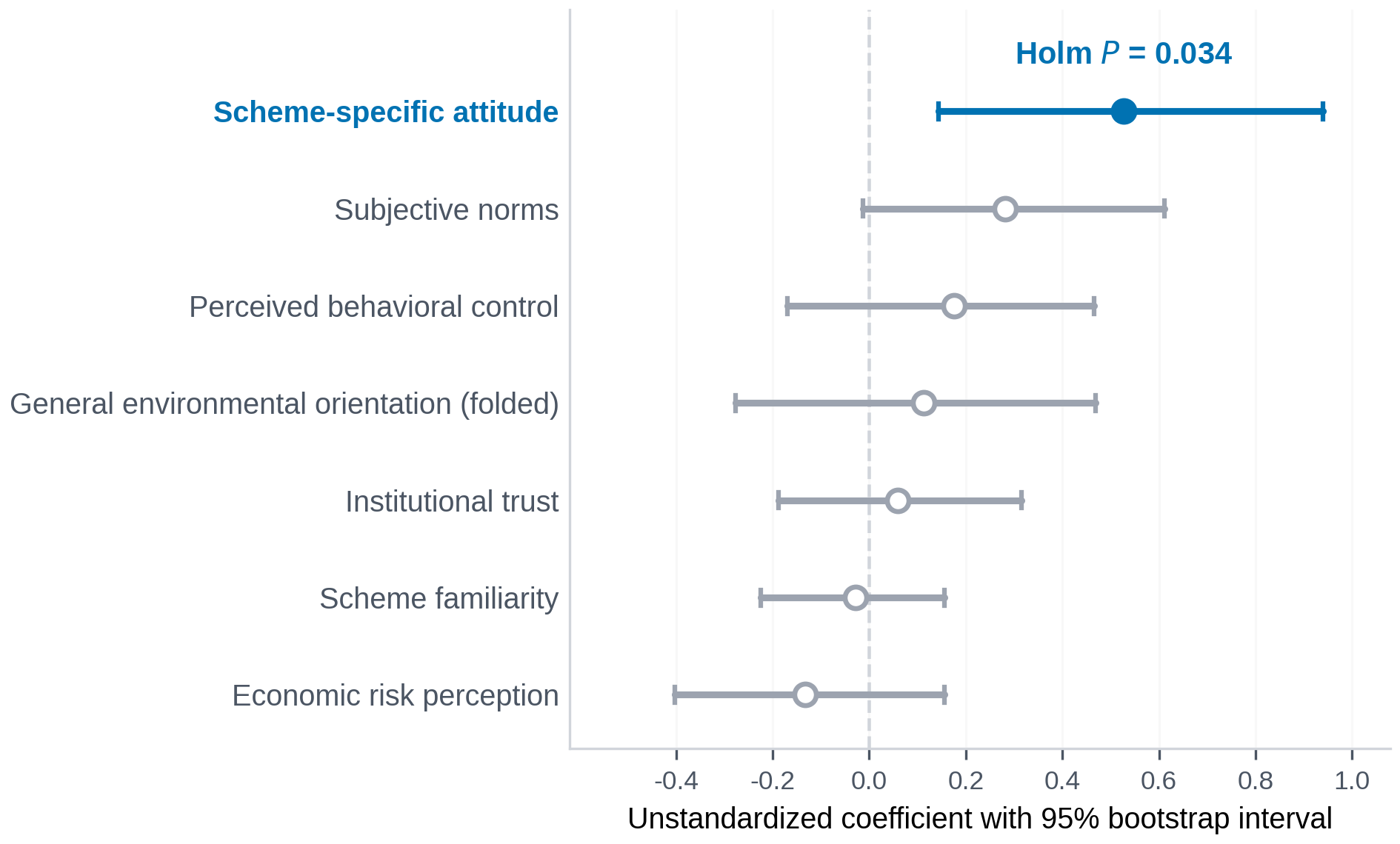
Caption: Model 3 coefficients on the primary outcome (n = 82) with bootstrap percentile 95 percent intervals (1000 resamples, seed 20260912). The scheme-specific attitude (blue, filled marker) is the only coefficient whose interval excludes zero; Holm P = 0.0343 in the seven-coefficient family. All other predictors are shown as open gray markers.
The specificity effect is robust to model class, sensitive to the uncertainty estimator
Table 3 assembles the attitude coefficient under changed estimation recipes; sign and magnitude stay stable across the five estimable specifications, and the ordered logit odds reach 4.18 per attitude point. Significance survives the conventional, ordered-logit and Cook-exclusion Holm readings but not HC3 or the association-clustered covariance. Clustered inference is the weakest leg, and Holm correction runs within each specification as predeclared in Methods.
Table 3. Robustness of the scheme-specific attitude coefficient
| Specification | n | B or OR | 95% CI | P raw | P Holm |
|---|---|---|---|---|---|
| Conventional OLS | 82 | +0.527 | [0.165, 0.888] | 0.0049 | 0.0343 |
| HC3, t reference | 82 | +0.527 | [0.089, 0.964] | 0.0190 | 0.1329 |
| Association-clustered CRV1, t(G-1) | 80 | +0.516 | [0.062, 0.969] | 0.0291 | 0.2036 |
| Ordered logit (odds ratio) | 82 | 4.18 | [1.57, 11.12] | 0.0042 | 0.0294 |
| Omit cases above 4/n Cook threshold | 76 | +0.599 | not computed | 0.0017 | 0.0119 |
| All composite items observed | 24 | +0.484 | unstable | 0.2051 | 1.0000 |
Block tests (HC3 Wald F, n = 82): trust and economic risk block P = 0.6517; orientation and familiarity block P = 0.8144.
Caption: Re-estimations of the model 3 attitude coefficient. Holm correction runs within the seven slopes of each specification, not across specifications. The clustered fit uses 13 association groups of 1 to 23 (identifier meaning unconfirmed, 2 cases lacking it); the ordered logit assumes proportional odds and independent observations; the Cook rerun omits 6 cases with nothing else changed; the all-items row is an unstable scoring-sensitivity bound, reported for completeness and not interpreted.
No other predictor survives correction
The nine group comparisons form their own Holm family; nothing in it survives. Perceived behavioral control shows the largest raw gap (3.40 versus 2.93, participants first, Mann-Whitney P = 0.0079, Cohen d = +0.699) and the environmental stewardship item, a single attitude item, second largest (P = 0.0122); their Holm values are 0.0707 and 0.0978. The bootstrap gap intervals agree; only perceived behavioral control excludes zero ([+0.194, +0.762]). Norms and the orientation composite come next (raw P = 0.0593 and 0.0616, both Holm P = 0.4148); economic risk perception (3.83 versus 4.09, raw P = 0.1526) and the attitude itself (2.85 versus 2.70, raw P = 0.3685) show no gaps. Institutional trust averages 2.96 of 5 (n = 88); participants sit at 3.01 and non-participants at 2.79 (Holm P = 0.6608).
Two design features bound every null here. The minimum detectable effect at 80 percent power is a partial correlation of 0.313 (f² = 0.109), larger under the Holm correction, so each null is a tolerance statement; the realized role split of 3.5 to 1 thins the non-participant side.
E4, the exploratory adverse-events contrast, is not testable here because the frozen analysis package holds no administrative-experience table.
Free texts on slope fit and delegated decisions
We coded 35 substantive free-text responses against a 15-code codebook; only 5 codes drew assignments. Slope fit leads at 7 of 35 responses (20.0 percent); respondents cite the sloping land where erosion pressure is highest. Delegated decisions follow at 6 of 35 (17.1 percent); the cooperative or its technician recommends the scheme and manages the application. Payment motives, scheme-specific praise and drought-flexibility requests account for 3, 3 and 2 assignments. Administrative burden, payment delay, erosion benefit, resigned acceptance and entitlement defense drew no assignments. With a single coder and no inter-coder agreement, the frequencies are descriptive, and the zero assignments are as indicative as the rest.
DISCUSSION
The compatibility reading
The results section's contrast is the compatibility principle landing where farmer studies rarely test it ⟦sok2021:c10⟧. That principle requires constructs to share target, action, context and time ⟦sok2021:c05⟧. In the review that articulated the rule, compatible measures explained 57 percent of intention variance on average against 40 for incompatible ones ⟦sok2021:c06⟧. Here the scheme-specific attitude carries intention (B = +0.527, Holm P = 0.0343, n = 82) while the general environmental orientation adds nothing (B = +0.113, Holm P = 1.000, same sample). That is the pattern the review's figures predict ⟦sok2021:c06⟧ under one live scheme, the attitude worth a third of a standard deviation per point (beta +0.333); the ordered logit agrees (OR 4.18, Holm P = 0.0294). The frame's extension logic conditions a predictor's place on incremental validity ⟦ajzen1991:c03⟧, what the orientation fails to show. The nearest full structural model gave norms the largest path on acceptable rather than good fit ⟦thapa2024:c01⟧ ⟦thapa2024:c05⟧; the asymmetry informs because both measures shared one survey. If the evaluation that counts names the scheme, design features are the attitude's content, and the implications below follow that thread.
Where trust lives and why the composite is null
Trust tells a sharper story than its null suggests. The composite correlates with the scheme attitude (Spearman rho +0.502) yet adds no incremental validity (B = +0.059, Holm P = 1.000; block test P = 0.652). The mean sits at 2.96 of 5 (sd 0.75, n = 88). The interior is not uniform, cooperative trust running 4.01 of 5 against 2.57 for the regional administration and 2.36 for payment stability, an average far from every object. The free texts show where the trust that matters lives, with 71.1 percent of farmers (n = 97, multi-select) naming the cooperative as an information source, which Andalusian work marks as needed for knowledge transfer ⟦carmonatorres2023:c09⟧; 6 of 35 responses (17.1 percent) describe it recommending the scheme or managing paperwork. Practical help built trust through a shared positive history ⟦devries2019:c03⟧, Andalusian research treats cooperatives as social references inseparable from rural society ⟦sanchezmartinez2020:c09⟧, and remote-sensing control, its authors argue, needs trust too ⟦villanueva2024:c06⟧. Trust in the regional authority predicts longer continuation while public technical advice works against it ⟦gatto2019:c06⟧, and Andalusian protest responses cite distrust of implementing agencies outright ⟦villanueva2024:c07⟧. Cooperative-routed communication borrows trust it did not earn, signing farmers up on the cooperative's word, not the paying agency's.
The measurement caution as a result
The measurement caution is a result, not an apology. A construct audit of the instrument as designed kept 5 of 7 composites; the failures are two-item pairs, farmer identity (alpha 0.261, opposing poles in a relative-priority wording) and collective efficacy (alpha 0.458, mixed constructs). The scored instrument folds the identity items into a five-item orientation composite (alpha 0.625), below the 0.67 to 0.75 band one study accepted and near another's accepted reliabilities ⟦niskanen2021:c10⟧ ⟦parra2022:c07⟧, and the collective items into norms, a choice the analysis package's decision register records. Norms trace positive raw associations that dissolve under every correction (Holm P = 0.661 in the regression, 0.415 in the group comparison). All three socio-psychological measures reach significance in the nearest full model ⟦thapa2024:c02⟧, peer information more than doubles continuation odds ⟦kuhfuss2016:c02⟧ while its framing moves nothing ⟦kuhfuss2016:c03⟧, yet social pressure ranks among the weakest longitudinal predictors ⟦gatto2019:c09⟧, and a composite blending both norm types inherits both channels' noise ⟦sok2021:c04⟧. A good-farmer identity that seems to discourage participation across European regions ⟦sander2024:c04⟧ makes the fragile reading plausible; salient beliefs are meant to be elicited from the study population ⟦ajzen1991:c04⟧. For studies printing general-orientation scales, an insignificant general attitude is what the compatibility principle predicts ⟦sok2021:c05⟧, not evidence that attitudes do not matter.
Limitations
Six fences bound the reading. The design is unbalanced (69 current, 20 eligible non-participant and 8 former farmers against a brief that assumed comparable cells), so the group comparisons are underpowered; with a minimum detectable partial correlation of 0.313 at 80 percent power the nulls are tolerance statements. The outcome is cross-sectional stated intention, not enrollment, which precludes causal inference ⟦vainio2021:c08⟧; intention meta-analytically explains 27 percent of variance in self-reported pro-environmental behavior ⟦bamberg2007:c01⟧, reporting bias may inflate even that ⟦bamberg2007:c03⟧, hypothetical settings invite strategic responding ⟦kathage2022:c10⟧ ⟦kuhfuss2016:c08⟧, and little ex-post evidence links design to decisions ⟦canessa2024:c06⟧. Composite items are 7.6 percent missing and missingness clusters within respondents (variance ratio 11.3), so scoring choices move cases as well as items. The qualitative strand has one coder and no inter-coder agreement. Clustered inference rests on 13 association groups of 1 to 23 with unconfirmed identifier meaning. A cooperative-recruited convenience sample can bias stated acceptance upward ⟦massfeller2022:c08⟧; recruited samples over-represent recruiter contacts ⟦canessa2023:c10⟧ ⟦topp2024:c07⟧. No causal language survives these fences.
Design implications
Two fences bound the implications. Stated-preference evidence needs triangulation with other methods before policy decisions ⟦schulze2024:c06⟧, and design heterogeneity across member states makes scheme effects hard to assess ⟦polakova2024:c06⟧. The free texts and the trust texture point to three moves. Drought flexibility comes first. Two of the 35 free texts (5.7 percent) ask for flexibility or report drought difficulty, force-majeure contracts recur among farmers' requests, and experts propose top-up or force-majeure budgets against delivery risk ⟦kelemen2023:c06⟧; whole-farm enrollment fell without license to intervene in problem spots in a vineyard scheme ⟦kuhfuss2015:c06⟧, and seeded covers risk costly establishment failure from Mediterranean storms and drought ⟦gomez2018:c07⟧. Recognition comes second. A modeled estimate suggests only 57 percent of existing Andalusian vegetation cover would meet eco-scheme requirements ⟦colombo2024:c03⟧, researchers assert many groves already run nature-based practices at moderate to high levels ⟦ruizcatedra2025:c07⟧, yet farmers across schemes read payments as compensation for practices they would run anyway ⟦bartkowski2023:c08⟧, the line the greening precedent crossed ⟦alons2017:c04⟧, funding existing practice risks windfalls ⟦peer2022:c02⟧ and risks rewarding incumbents at the expense of additionality, payments changing practice rather than rewarding it ⟦canessa2024:c08⟧ ⟦zielinski2025:c07⟧. Payment timeliness comes third. Payment stability is the lowest trust item (2.36 of 5) and payment reliability the third lowest (2.73 of 5); irregular and delayed aid scored 2.67 of 3 as a limiting factor for meat goat farmers ⟦moralesjerrett2020:c01⟧, and modeled payments fall below the scheduled rate once the envelope binds ⟦colombo2024:c06⟧. Free technical-administrative help raises stated participation in a vineyard AES ⟦kuhfuss2015:c04⟧, and the cooperative channel is a documented participation predictor elsewhere ⟦perezsanchez2024:c02⟧, so it reaches the already-reachable; two-way administration-farmer channels ⟦rodriguezsousa2020:c09⟧ are the next step.
Steering the social-ecological system
The paper asked which attitude counts; the answer is the attitude that names the scheme. The general orientation adds nothing beyond it, norms inherit their instrument, and the trust that matters is cooperative. Steering this social-ecological system runs through the scheme's content. The groves set biophysical terms, spring control of covers to protect soil water ⟦gomez2014:c04⟧ and, one proposal urges, rules that ease when adverse climate makes outcomes unattainable ⟦villanueva2024:c08⟧. US Conservation Reserve Program recommendations likewise urge pairing financial and non-financial motivations ⟦thapa2024:c11⟧, and results-based designs, one Andalusian group argues, would require institutions that reduce information asymmetry and reinforce mutual trust ⟦granadodiaz2024:c08⟧; recognition appeals to those who see farming as already delivering ecosystem services, in Finnish farmer and citizen surveys ⟦vainio2021:c11⟧. Coordinated implementation within target areas is recommended for wider ecological gains and community benefits ⟦peer2022:c08⟧. That is steering here, a named signal through a trusted channel, inside the water limits the groves set.
LITERATURE CITED
Ajzen, I. 1991. The theory of planned behavior. Organizational Behavior and Human Decision Processes 50(2):179-211 https://doi.org/10.1016/0749-5978(91)90020-T
Alfonso Gómez, J. 2026. Desertification in Olive Orchards: A Complex Challenge for a Diverse Agricultural System. The Labyrinth of Desertification. https://doi.org/10.1007/978-3-032-09648-7_15
Alons, G. 2017. Environmental policy integration in the EU’s common agricultural policy: greening or greenwashing?. Journal of European Public Policy 24(11):1604-1622 https://doi.org/10.1080/13501763.2017.1334085
Arias-Giraldo, L. F., G. Guzmán, M. Montes-Borrego, D. Gramaje, J. A. Gómez and B. B. Landa. 2021. Going Beyond Soil Conservation with the Use of Cover Crops in Mediterranean Sloping Olive Orchards. Agronomy 11(7):1387 https://doi.org/10.3390/agronomy11071387
Bamberg, S. and G. Möser. 2007. Twenty years after Hines, Hungerford, and Tomera: A new meta-analysis of psycho-social determinants of pro-environmental behaviour. Journal of Environmental Psychology 27(1):14-25 https://doi.org/10.1016/j.jenvp.2006.12.002
Bartkowski, B., C. Schüßler and B. Müller. 2022. Typologies of European farmers: approaches, methods and research gaps. Regional Environmental Change 22(2). https://doi.org/10.1007/s10113-022-01899-y
Bartkowski, B., M. Beckmann, M. Bednář, S. Biffi, C. Domingo-Marimon, M. Mesaroš, C. Schüßler, B. Šarapatka, S. Tarčak, T. Václavík, G. Ziv and F. Wittstock. 2023. Adoption and potential of agri-environmental schemes in Europe: Cross-regional evidence from interviews with farmers. People and Nature 5(5):1610-1621 https://doi.org/10.1002/pan3.10526
Bartkowski, B., N. Droste, M. Ließ, W. Sidemo-Holm, U. Weller and M. V. Brady. 2021. Payments by modelled results: A novel design for agri-environmental schemes. Land Use Policy 102:105230 https://doi.org/10.1016/j.landusepol.2020.105230
Canessa, C., A. Ait-Sidhoum, S. Wunder and J. Sauer. 2024. What matters most in determining European farmers’ participation in agri-environmental measures? A systematic review of the quantitative literature. Land Use Policy 140:107094 https://doi.org/10.1016/j.landusepol.2024.107094
Canessa, C., T. E. Venus, M. Wiesmeier, P. Mennig and J. Sauer. 2023. Incentives, Rewards or Both in Payments for Ecosystem Services: Drawing a Link Between Farmers' Preferences and Biodiversity Levels. Ecological Economics 213:107954 https://doi.org/10.1016/j.ecolecon.2023.107954
Carmona-Torres, C., C. Parra-López, S. Sayadi and L. Reina-Usuga. 2023. Abandonment factors and alternatives in sloping olive growing: The case of Andalusia, Spain. Land Use Policy 132:106836 https://doi.org/10.1016/j.landusepol.2023.106836
Cerdà, A., I. Franch-Pardo, A. Novara, S. Sannigrahi and J. Rodrigo-Comino. 2022. Examining the Effectiveness of Catch Crops as a Nature-Based Solution to Mitigate Surface Soil and Water Losses as an Environmental Regional Concern. Earth Systems and Environment 6(1):29-44 https://doi.org/10.1007/s41748-021-00284-9
Chapman, M., S. Wiltshire, P. Baur, T. Bowles, L. Carlisle, F. Castillo, K. Esquivel, S. Gennet, A. Iles, D. Karp, C. Kremen, J. Liebert, E. M. Olimpi, J. Ory, M. Ryan, A. Sciligo, J. Thompson, H. Waterhouse and C. Boettiger. 2022. Social-ecological feedbacks drive tipping points in farming system diversification. One Earth 5(3):283-292 https://doi.org/10.1016/j.oneear.2022.02.007
Colombo, S. and B. Rocamora-Montiel. 2018. Result-oriented Agri-Environmental Climate Schemes as a means of promoting climate change mitigation in olive growing. Outlook on Agriculture 47(2):141-149 https://doi.org/10.1177/0030727018770931
Colombo, S., J. Castro-Rodríguez, D. Peréz-Pérez and M. Almagro. 2024. Analysis of the environmental and economic performance of common agricultural policy eco-schemes in soil organic carbon sequestration. Ecological Economics 220:108183 https://doi.org/10.1016/j.ecolecon.2024.108183
Cuadros-Casanova, I., A. Cristiano, D. Biancolini, M. Cimatti, A. A. Sessa, V. Y. Mendez Angarita, C. Dragonetti, M. Pacifici, C. Rondinini and M. Di Marco. 2023. Opportunities and challenges for Common Agricultural Policy reform to support the European Green Deal. Conservation Biology 37(3). https://doi.org/10.1111/cobi.14052
de Vries, J. R., E. van der Zee, R. Beunen, R. Kat and P. H. Feindt. 2019. Trusting the People and the System. The Interrelation Between Interpersonal and Institutional Trust in Collective Action for Agri-Environmental Management. Sustainability 11(24):7022 https://doi.org/10.3390/su11247022
Dessart, F. J., J. Barreiro-Hurlé and R. van Bavel. 2019. Behavioural factors affecting the adoption of sustainable farming practices: a policy-oriented review. European Review of Agricultural Economics 46(3):417-471 https://doi.org/10.1093/erae/jbz019
Epanchin-Niell, R. S., D. B. Jackson-Smith, R. S. Wilson, M. Ashenfarb, A. A. Dayer, V. Hillis, G. D. Iacona, E. M. Markowitz, S. T. Marquart-Pyatt and T. Treakle. 2022. Private land conservation decision-making: An integrative social science model. Journal of Environmental Management 302:113961 https://doi.org/10.1016/j.jenvman.2021.113961
ESYRCE. 2015. Junta de Andalucía / AGAPA, Análisis de las plantaciones de olivar en Andalucía. Año 2015 (ESYRCE). [metadata incomplete: verify before submission] [APA record unverified in the corpus]
European Union. 2024. Regulation (EU) 2024/1468 of the European Parliament and of the Council of 14 May 2024 amending Regulations (EU) 2021/2115 and (EU) 2021/2116 as regards good agricultural and environmental condition standards, schemes for climate, environment and animal welfare, amendment of the CAP Strategic Plans, review of the CAP Strategic Plans and exemptions from controls and penalties. [metadata incomplete: verify before submission] [APA record unverified in the corpus]
Francaviglia, R., M. Almagro and J. L. Vicente-Vicente. 2023. Conservation Agriculture and Soil Organic Carbon: Principles, Processes, Practices and Policy Options. Soil Systems 7(1):17 https://doi.org/10.3390/soilsystems7010017
Fritsche, I., M. Barth, P. Jugert, T. Masson and G. Reese. 2018. A Social Identity Model of Pro-Environmental Action (SIMPEA). Psychological Review 125(2):245-269 https://doi.org/10.1037/rev0000090
Gatto, P., D. Mozzato and E. Defrancesco. 2019. Analysing the role of factors affecting farmers’ decisions to continue with agri-environmental schemes from a temporal perspective. Environmental Science & Policy 92:237-244 https://doi.org/10.1016/j.envsci.2018.12.001
Gómez, J. A., M. Campos, G. Guzmán, F. Castillo-Llanque, T. Vanwalleghem, Á. Lora and J. V. Giráldez. 2018. Soil erosion control, plant diversity, and arthropod communities under heterogeneous cover crops in an olive orchard. Environmental Science and Pollution Research 25(2):977-989 https://doi.org/10.1007/s11356-016-8339-9
Gómez, J., J. Infante-Amate, M. De Molina, T. Vanwalleghem, E. Taguas and I. Lorite. 2014. Olive Cultivation, its Impact on Soil Erosion and its Progression into Yield Impacts in Southern Spain in the Past as a Key to a Future of Increasing Climate Uncertainty. Agriculture 4(2):170-198 https://doi.org/10.3390/agriculture4020170
Granado-Díaz, R., S. Colombo, M. Romero-Varo and A. J. Villanueva. 2024. Farmers' attitudes toward the use of digital technologies in the context of agri-environmental policies. Agricultural Systems 221:104129 https://doi.org/10.1016/j.agsy.2024.104129
Gütschow, M., B. Bartkowski and M. R. Felipe-Lucia. 2021. Farmers’ action space to adopt sustainable practices: a study of arable farming in Saxony. Regional Environmental Change 21(4). https://doi.org/10.1007/s10113-021-01848-1
Han, G. and M. T. Niles. 2023. An adoption spectrum for sustainable agriculture practices: A new framework applied to cover crop adoption. Agricultural Systems 212:103771 https://doi.org/10.1016/j.agsy.2023.103771
Homet, P., M. Á. Gallardo-Reina, J. F. Aguiar, I. M. Liberal, R. Casimiro-Soriguer and R. Ochoa-Hueso. 2024. Viticulture and the European Union's Common Agricultural Policy (CAP): Historical overview, current situation and future perspective. Journal of Sustainable Agriculture and Environment 3(2). https://doi.org/10.1002/sae2.12099
Janssen, C., P. Gorris, C. Pahl-Wostl and L. Schwarz. 2026. The social-ecological learning framework: perception, action, and learning in a changing world. Global Environmental Change 98:103159 https://doi.org/10.1016/j.gloenvcha.2026.103159
Kathage, J., B. Smit, B. Janssens, W. Haagsma and J. L. Adrados. 2022. How much is policy driving the adoption of cover crops? Evidence from four EU regions. Land Use Policy 116:106016 https://doi.org/10.1016/j.landusepol.2022.106016
Kelemen, E., B. Megyesi, B. Matzdorf, E. Andersen, L. G. van Bussel, M. Dumortier, C. Dutilly, M. García-Llorente, C. Hamon, A. LePage, R. Moruzzo, K. Prager, F. Riccioli and C. Yacamán-Ochoa. 2023. The prospects of innovative agri-environmental contracts in the European policy context: Results from a Delphi study. Land Use Policy 131:106706 https://doi.org/10.1016/j.landusepol.2023.106706
Kuhfuss, L., R. Préget, S. Thoyer and N. Hanley. 2015. Nudging farmers to enrol land into agri-environmental schemes: the role of a collective bonus. European Review of Agricultural Economics 43(4):609-636 https://doi.org/10.1093/erae/jbv031
Kuhfuss, L., R. Préget, S. Thoyer, N. Hanley, P. L. Coent and M. Désolé. 2016. Nudges, Social Norms, and Permanence in Agri-environmental Schemes. Land Economics 92(4):641-655 https://doi.org/10.3368/le.92.4.641
López-Bernal, Á., O. García-Tejera, L. Testi and F. J. Villalobos. 2023. Modelling the impacts of cover crop management strategies on the water use, carbon exchange and yield of olive orchards. Journal of Forestry Research 34(1):283-295 https://doi.org/10.1007/s11676-022-01570-6
Mack, G., A. Kohler, K. Heitkämper and N. El-Benni. 2019. Determinants of the perceived administrative transaction costs caused by the uptake of an agri-environmental program. Journal of Environmental Planning and Management 62(10):1802-1819 https://doi.org/10.1080/09640568.2018.1515311
Mack, G., C. Ritzel, K. Heitkämper and N. El Benni. 2021. The Effect of Administrative Burden on Farmers’ Perceptions of Cross-Compliance-Based Direct Payment Policy. Public Administration Review 81(4):664-675 https://doi.org/10.1111/puar.13335
MAPA. 2025. La campaña PAC 2025 registra más de 582.000 solicitudes y 22 millones de hectáreas declaradas en toda España. [metadata incomplete: verify before submission] [APA record unverified in the corpus]
Massfeller, A., M. Meraner, S. Hüttel and R. Uehleke. 2022. Farmers' acceptance of results-based agri-environmental schemes: A German perspective. Land Use Policy 120:106281 https://doi.org/10.1016/j.landusepol.2022.106281
Morales-Jerrett, E., J. M. Mancilla-Leytón, M. Delgado-Pertíñez and Y. Mena. 2020. The Contribution of Traditional Meat Goat Farming Systems to Human Wellbeing and Its Importance for the Sustainability of This Livestock Subsector. Sustainability 12(3):1181 https://doi.org/10.3390/su12031181
Muñoz-Ulecia, E., P. Uldemolins, A. Bernués, T. de-Magistris, S. Villamayor-Tomás and D. Martín-Collado. 2025. Fighting the pollinators decline in practice - Farmers’ willingness to accept an eco-scheme for their conservation in Aragon, Spain. Resources, Environment and Sustainability 20:100208 https://doi.org/10.1016/j.resenv.2025.100208
Niskanen, O., A. Tienhaara, E. Haltia and E. Pouta. 2021. Farmers’ heterogeneous preferences towards results-based environmental policies. Land Use Policy 102:105227 https://doi.org/10.1016/j.landusepol.2020.105227
Ouro Aghouda. 2024. Farmers’ Willingness to Participate in Collective Results-based Agri-environment- and-Climate Schemes: A Choice Experiment in Southern Spain. [metadata incomplete: verify before submission] [APA record unverified in the corpus]
Parra, G., L. J. Garcia-Lopez, J. A. Piqueras and R. García. 2022. Identification of Farmers’ Barriers to Implement Sustainable Management Practices in Olive Groves. Sustainability 14(11):6451 https://doi.org/10.3390/su14116451
Pe'er, G., J. A. Finn, M. Díaz, M. Birkenstock, S. Lakner, N. Röder, Y. Kazakova, T. Šumrada, P. Bezák, E. D. Concepción, J. Dänhardt, M. B. Morales, I. Rac, J. Špulerová, S. Schindler, M. Stavrinides, S. Targetti, D. Viaggi, I. N. Vogiatzakis and H. Guyomard. 2022. How can the European Common Agricultural Policy help halt biodiversity loss? Recommendations by over 300 experts. Conservation Letters 15(6). https://doi.org/10.1111/conl.12901
Peñuela, A., E. J. González-Sánchez and F. Milazzo. 2026. Soil erosion in Mediterranean olive groves: a review. SOIL 12(1):93-111 https://doi.org/10.5194/soil-12-93-2026
Pérez-Sánchez, C., A. B. Pierri-Daunt and S. Villamayor-Tomas. 2024. Unraveling spatial agglomeration patterns in agri-environmental schemes: Evidence from the improvement of steppe habitats in the Natura 2000 network in Catalonia (Spain). Land Use Policy 142:107145 https://doi.org/10.1016/j.landusepol.2024.107145
Poláková, J., J. Humpál, A. Svoboda and J. Soukup. 2024. Interpreting Different Narratives about Land Services and Land Use Economics of Common Agricultural Policy. Land 13(5):620 https://doi.org/10.3390/land13050620
Ranjan, P., S. P. Church, K. Floress and L. S. Prokopy. 2019. Synthesizing Conservation Motivations and Barriers: What Have We Learned from Qualitative Studies of Farmers’ Behaviors in the United States?. Society & Natural Resources 32(11):1171-1199 https://doi.org/10.1080/08941920.2019.1648710
REDR. 2025. REDR PAC / MAPA, "Los ecorregímenes en el Plan Estratégico de la PAC español". [metadata incomplete: verify before submission] [APA record unverified in the corpus]
Rodríguez Sousa, A. A., C. Parra-López, S. Sayadi-Gmada, J. M. Barandica and A. J. Rescia. 2020. Evaluation of the Objectives and Concerns of Farmers to Apply Different Agricultural Managements in Olive Groves: The Case of Estepa Region (Southern, Spain). Land 9(10):366 https://doi.org/10.3390/land9100366
Ruiz-Cátedra, G., J. Calero, P. Domouso and R. García-Ruiz. 2025. Do management practices which enhance nature-based processes improve soil health in olive groves?. Geoderma 457:117276 https://doi.org/10.1016/j.geoderma.2025.117276
Sánchez-Martínez, J. D., J. C. Rodríguez-Cohard, A. Garrido-Almonacid and V. J. Gallego-Simón. 2020. Social Innovation in Rural Areas? The Case of Andalusian Olive Oil Co-Operatives. Sustainability 12(23):10019 https://doi.org/10.3390/su122310019
Sander, A., J. Ghazoul, R. Finger and S. Schaub. 2024. Participation in individual and collective agri-environmental schemes: A synthesis using the Theory of Planned Behaviour. Journal of Rural Studies 107:103255 https://doi.org/10.1016/j.jrurstud.2024.103255
Sastre, B., C. Barbero-Sierra, R. Bienes, M. J. Marques and A. García-Díaz. 2017. Soil loss in an olive grove in Central Spain under cover crops and tillage treatments, and farmer perceptions. Journal of Soils and Sediments 17(3):873-888 https://doi.org/10.1007/s11368-016-1589-9
Schaub, S., J. Ghazoul, R. Huber, W. Zhang, A. Sander, C. Rees, S. Banerjee and R. Finger. 2023. The role of behavioural factors and opportunity costs in farmers' participation in voluntary agri-environmental schemes: A systematic review. Journal of Agricultural Economics 74(3):617-660 https://doi.org/10.1111/1477-9552.12538
Schulte, M., S. Bamberg, J. Rees and P. Rollin. 2020. Social identity as a key concept for connecting transformative societal change with individual environmental activism. Journal of Environmental Psychology 72:101525 https://doi.org/10.1016/j.jenvp.2020.101525
Schulze, C., K. Zagórska, K. Häfner, O. Markiewicz, M. Czajkowski and B. Matzdorf. 2024. Using farmers' ex ante preferences to design agri-environmental contracts: A systematic review. Journal of Agricultural Economics 75(1):44-83 https://doi.org/10.1111/1477-9552.12570
Sok, J., J. R. Borges, P. Schmidt and I. Ajzen. 2021. Farmer Behaviour as Reasoned Action: A Critical Review of Research with the Theory of Planned Behaviour. Journal of Agricultural Economics 72(2):388-412 https://doi.org/10.1111/1477-9552.12408
Tama, R. A. Z., L. Ying, M. Yu, M. M. Hoque, K. M. Adnan and S. A. Sarker. 2021. Assessing farmers’ intention towards conservation agriculture by using the Extended Theory of Planned Behavior. Journal of Environmental Management 280:111654 https://doi.org/10.1016/j.jenvman.2020.111654
Thapa, B., B. P. Chapagain, S. T. McMurry, L. M. Smith and O. Joshi. 2024. Understanding landowner participation in the Conservation Reserve Program in the U.S. High Plains region. Land Use Policy 141:107163 https://doi.org/10.1016/j.landusepol.2024.107163
Topp, E., A. Stephan, E. Varela, H. Cicek and T. Plieninger. 2024. Mediterranean farmers’ understandings of ‘good soil management’ and ‘good farmer’ identity in the context of conservation agriculture. International Journal of Agricultural Sustainability 22(1). https://doi.org/10.1080/14735903.2024.2335083
Vainio, A., A. Tienhaara, E. Haltia, T. Hyvönen, J. Pyysiäinen and E. Pouta. 2021. The legitimacy of result-oriented and action-oriented agri-environmental schemes: A comparison of farmers’ and citizens’ perceptions. Land Use Policy 107:104358 https://doi.org/10.1016/j.landusepol.2019.104358
Villanueva, A. J., R. Granado-Díaz and S. Colombo. 2024. Comparing practice- and results-based agri-environmental schemes controlled by remote sensing: An application to olive groves in Spain. Journal of Agricultural Economics 75(2):524-545 https://doi.org/10.1111/1477-9552.12573
Zieliński, M., W. Józwiak, A. Żak and T. Rokicki. 2025. Development of Eco-Schemes as an Important Environmental Measure in Areas Facing Natural or Other Specific Constraints Under the Common Agriculture Policy 2023-2027: Evidence from Poland. Sustainability 17(6):2781 https://doi.org/10.3390/su17062781
Zuazo, V. H. D., B. C. Rodríguez, I. F. García-Tejero, B. G. Ruiz and S. C. Tavira. 2020. Benefits of organic olive rainfed systems to control soil erosion and runoff and improve soil health restoration. Agronomy for Sustainable Development 40(6). https://doi.org/10.1007/s13593-020-00644-1
Appendix 1. Measures
This appendix holds the measurement detail behind the Measures subsection: construct and item mapping, response scales, scoring rules, outcome recoding, reliability and the construct audit.
Item inventory and construct mapping
As designed, the instrument operationalizes seven constructs: attitudes toward eco-schemes (9 items), subjective norms (4), perceived behavioral control (6), institutional trust (6), risk perception (3), farmer identity (2) and collective efficacy (2). The scored structure carries 33 items in six composites: scheme-specific attitude (6), subjective norms (6, the four norms items plus the two collective-efficacy items), perceived behavioral control (6), institutional trust (6), general environmental orientation (5, the two identity items plus three items from the as-designed attitude scale) and economic risk (4). Scheme familiarity enters the models as a single item with its own familiarity anchor. Item keys held in the frozen pack are the six trust items (trust_regional, trust_coop, trust_advisors, trust_stability, trust_fair, trust_payment), the two identity items (identity_producer, identity_steward), the two collective items (collective_efficacy, collective_trust) and the flagged attitude item att_biodiv. In content, the as-designed norms items cover peer participation behavior, peer opinion in the area, family support and cooperative encouragement; the perceived control items cover knowledge adequacy, resource availability, time availability, administrative self-efficacy, decisional autonomy and practice compatibility; the as-designed attitude items cover environmental attitudes, perceived scheme benefits and perceived legitimacy and cost; the risk items cover worry about production loss, unintentional non-compliance penalties and climate interference with scheme requirements.
Response scales
All items are five-point with endpoint-only verbal anchors. Agreement items run from Strongly disagree (1) to Strongly agree (5), trust items from No trust (1) to Complete trust (5), worry items from Not worried at all (1) to Very worried (5), and familiarity items from Not familiar at all (1) to Completely familiar (5). The construct audit warns that the trust block mixes two anchor sets over the same object type.
Scoring rules
Each composite is the mean of its available items and is scored only when at least half of the scale's items are answered; otherwise the composite is missing. Negatively worded items are reverse-coded before scoring. Prefer-not-to-say answers (94 markers across 36 columns) are treated as missing, never as a scale point. Against listwise deletion, available-item scoring recovers 12 cases for general environmental orientation, 13 for scheme-specific attitude, 21 for subjective norms, 16 for perceived behavioral control, 22 for institutional trust and 7 for economic risk. Composite items are 7.6 percent missing overall (2.52 of 33 items per farmer). Missingness clusters within respondents; blank-count variance is 25.67 against an independence benchmark of 2.27 (ratio 11.3), and 348 of 528 estimable item pairs exceed an absolute phi of 0.20; the mechanism is not identified.
Outcome recoding
Each cohort answers its own role-gated five-point intention item: current participants a continuation item, former participants a re-entry item, eligible non-participants an entry item. The primary outcome, int_participate_next, recodes the answered branch item onto a single five-point measure; the pooled branched outcome keeps the answered branch item unchanged and is the secondary reading.
Reliability
Cronbach alphas are computed on complete cases; the intervals are bootstrap percentile 95 percent bounds from 2000 draws with seed 20260912. The trust alpha's complete-case sample is n = 66.
| Composite (scored) | Items | Alpha | Bootstrap 95 percent interval |
|---|---|---|---|
| Scheme-specific attitude | 6 | 0.723 | [0.577, 0.806] |
| Subjective norms | 6 | 0.733 | [0.606, 0.813] |
| Perceived behavioral control | 6 | 0.750 | [0.647, 0.821] |
| Institutional trust | 6 | 0.819 | [0.744, 0.872] |
| General environmental orientation (folded) | 5 | 0.625 | [0.490, 0.737] |
| Economic risk | 4 | 0.650 | [0.450, 0.776] |
One of the 33 scored items, att_biodiv, falls below a 0.30 item-rest correlation (r = +0.200); the threshold is a rule of thumb and nothing was dropped on this evidence.
Construct audit
The audit tests each as-designed composite for length, a shared response scale and unidimensionality; 5 of 7 survive. Farmer identity fails the length test and unidimensionality, its two items occupying opposing poles of a relative-priority wording (alpha 0.261, r = +0.150); collective efficacy fails both tests as well, its items mixing constructs (alpha 0.458, r = +0.297). The defensible as-designed attitude scale (9 items) scores 0.694 and the norms scale (4 items) 0.692. The scored structure folds the identity items into the five-item general environmental orientation composite and the collective items into subjective norms. Under the analysis package's decision register entry D-009, the choice of scoring and primary outcome is itself recorded, and dropping items needs a substantive argument.
Data and code availability (submission-form draft)
The journal publishes this statement with the article; it is supplied in the submission form, not in the body file. The statement below follows the journal's template for derived data with privacy constraints and must be completed by the author before submission.
Statement to paste into the submission form
The survey data underlying this article contain personal identifiers linked to a small population of farmers in a single region and cannot be shared in identifying form. An anonymized, row-level extract of the survey responses, the exact analysis scripts that produce every number in the paper (analysis of record: the frozen package on the 2026-08-13 export, sha256 prefix ccb617669cf2100c, Python 3.14.4 with statsmodels 0.15.0 and scipy 1.18.1), and the qualitative coding sheet will be deposited in a public repository (OSF, recommended) upon acceptance, or are available on reasonable request subject to the approving ethics body's constraints. [ETHICS APPROVAL PENDING: the approving body and approval number must be inserted here and in the Methods section; see callout ES-C01 and author question Q7.]
What is held now
- Frozen analysis pack: upload/august_13 (7 frozen table files, diagnostics, psychometrics, qualitative coding, manifest with sha256).
- Claim corpus: upload/data.json (875 claims, 157 sources) backing every literature citation.
- Working tools: tools/ in both paper trees (paperquery.py, citekey_convert.py, paper_check.py, verify_numbers.py).
Open items before submission
- Ethics approval reference (body + this statement).
- Repository DOI for the anonymized data and scripts.
- Author decision FR-03: whether the suppressed exploratory adverse-events contrast is re-run on the frozen export and registered as exploratory.